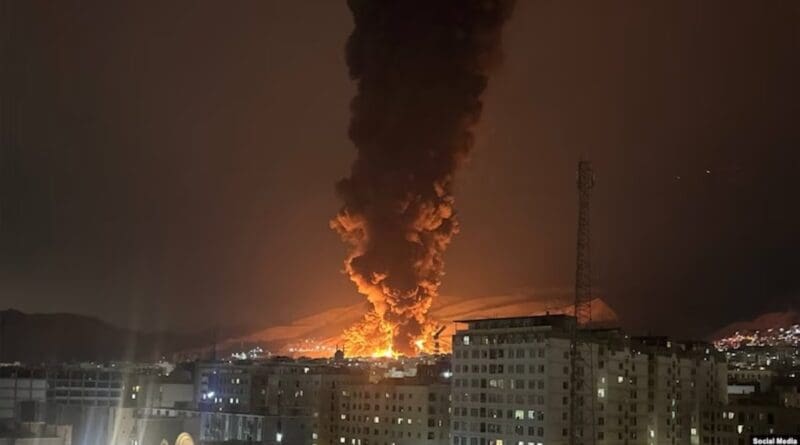
Blasts shake an oil depot near Tehran on March 7 following an Israeli air strike. Photo Credit: RFE/RL, Social Media
Key Takeaways:
Modern warfare is a major environmental and climate event: military activity, fires, and infrastructure destruction generate large greenhouse gas emissions and toxic pollution, yet these emissions remain largely excluded from international climate reporting.
Conflicts such as the ongoing Middle East fighting disrupt global energy markets and chokepoints, pushing countries—including those in Southeast Asia—back toward fossil fuels and creating a vicious cycle that slows the energy transition.
Climate diplomacy must evolve by measuring and reporting military emissions, linking climate policy with regional security and energy cooperation, and treating war itself as part of the climate crisis rather than an exception to it.
As US-Israel and Iran-Hezbollah have continued strikes for now after their ceasefire collapsed, the Middle East is again proving a brutal point: war does not stay in one lane. That is why the old way of talking about war is no longer enough. The conflict is still described in the language of geopolitics: deterrence, sovereignty, territory, power. It is still framed as either a security crisis or a humanitarian tragedy. Both are true. But both are incomplete.
War is also an environmental event. It burns fuel, levels infrastructure, poisons air and water, and tears apart the energy systems on which modern life depends. It leaves behind not only ruins, but also emissions. And in doing so, it exposes one of the biggest blind spots in climate diplomacy: the military-industrial complex is still treated as if it floats above the climate problem, untouched by the very crisis it helps deepen.
An analysis estimates that the first two weeks of the US-Israel vs. Iran confrontation produced around 5 million tons of carbon dioxide equivalent through military activity, fires and destroyed infrastructure — and that was before the conflict entered its current, far longer phase. When military strikes hit oil facilities, refineries and storage sites, the damage exceeds the border. Toxic pollutants spread through the atmosphere and the sea, affecting civilians and ecosystems far beyond the battlefield.
Zoom out, and the picture is even more disturbing. Scientists have estimated that military-related emissions account for about 5.5 percent of global greenhouse gas emissions. If the world’s armed forces were counted as a country, they would rank among the biggest emitters on Earth. Yet military emissions remain outside the core architecture of international climate reporting. That is not a technical omission. It is a political choice. It is the climate regime looking away from the gun barrel.
War also shocks the energy system. Disruption in the Strait of Hormuz, or any other chokepoint for oil and gas, ripples through markets everywhere almost immediately, and Southeast Asia’s experience over the past several months is the clearest evidence. Geopolitical conflicts thousands of kilometers away can still set the price of gasoline in Indonesia or the availability of LNG in the Philippines within days. The region remains heavily exposed to Middle East oil and gas markets while pursuing genuinely ambitious renewable energy targets.
Here lies the nasty logic of carbon lock-in more broadly. Countries that swear allegiance to decarbonization often rush back to fossil fuels when security is threatened. It is structural dependence. In a crisis, states do what states always do: they prioritize immediate survival over climate goals. The result is a vicious carbon loop in which conflict increases emissions directly and also slows the transition that would reduce them.
That pattern is exactly why climate diplomacy keeps hitting a wall. It still tends to imagine emissions as the product of factories, cars and power plants, not covering warcraft, missiles and blockades — and it still tends to treat energy security and climate policy as separate conversations.
Security and climate are not separate policy silos. They are fused in the real world, where war can trigger an energy crisis, and an energy crisis can drag a country back toward fossil dependence. (That is why delays to the energy transition forced by a distant war only deepen that vulnerability the next time a chokepoint closes — and there is little reason to think this will be the last time.)
The irony is sharp: the more unstable the world becomes, the more difficult it is to keep climate ambition alive. The rules of international politics reward realism, not idealism. This is simply how states behave when threatened: immediate security beats long-term collective goods, every time. Climate action suffers because it asks governments to think beyond the next shock, while war forces them to think only about the next one.
This is also why diplomacy must evolve. How? First, military emissions need to be measured and reported. If climate transparency excludes armed conflict, it is not transparent.
Second, climate diplomacy has to be linked with regional security cooperation. The renewed urgency behind the long-stalled ASEAN Power Grid — and the fact that member states are now treating cross-border power trade as an energy security necessity rather than a distant aspiration — shows that energy resilience and global security are no longer separable questions.
Third, the legal basis is getting stronger. The International Court of Justice declared the Paris Agreement’s 1.5°C target legally binding on states, and that states have legal duties under customary international law to prevent significant climate harm. It gives diplomats more ground to connect environmental harm — including the environmental harm of war itself — with state responsibility.
The lesson is plain. Climate change cannot be understood apart from geopolitics, and geopolitics cannot be separated from climate consequences. War is not an exception to climate policy. It is part of the climate story — and Southeast Asia, more than most regions, is living proof of it. If diplomacy wants to remain credible in an era of rising conflict, it must stop pretending otherwise.
****
By Irvan T. Harja, researcher and strategist specializing in climate justice at The Habibie Center.
This article was published in eurasiareview on August 4, 2026