SYNOPSIS
Once perceived as a threat to ASEAN centrality, the Quadrilateral Security Dialogue (Quad) has increasingly signalled support for ASEAN’s leadership in the Indo-Pacific. ASEAN must capitalise on the Quad’s support to integrate the minilateral group’s position into the ASEAN-led regional architecture while pursuing the practical implementation of the ASEAN Outlook on the Indo-Pacific, particularly in maritime and energy security and disaster management.
COMMENTARY
ASEAN and the Quad, a minilateral group comprising the United States, Japan, Australia, and India, have long been seen as holding competing visions for the Indo-Pacific region. While the Quad envisages a cross-regional security network in response to a common threat, as reflected in the Free and Open Indo-Pacific (FOIP) strategy of its members, ASEAN envisions the Indo-Pacific as a region of inclusive cooperation for all countries, as encapsulated in the ASEAN Outlook on the Indo-Pacific (AOIP).
Quad’s latest statement of support for ASEAN offers an opportunity to bridge this gap and advance practical cooperation, anchored in an ASEAN-led mechanism. The Quad’s support comes at a timely moment, as the Philippines is set to host the 49th ASEAN Summit from 16 to 18 November this year.
Timely Support Amid Uncertainty in the Indo-Pacific
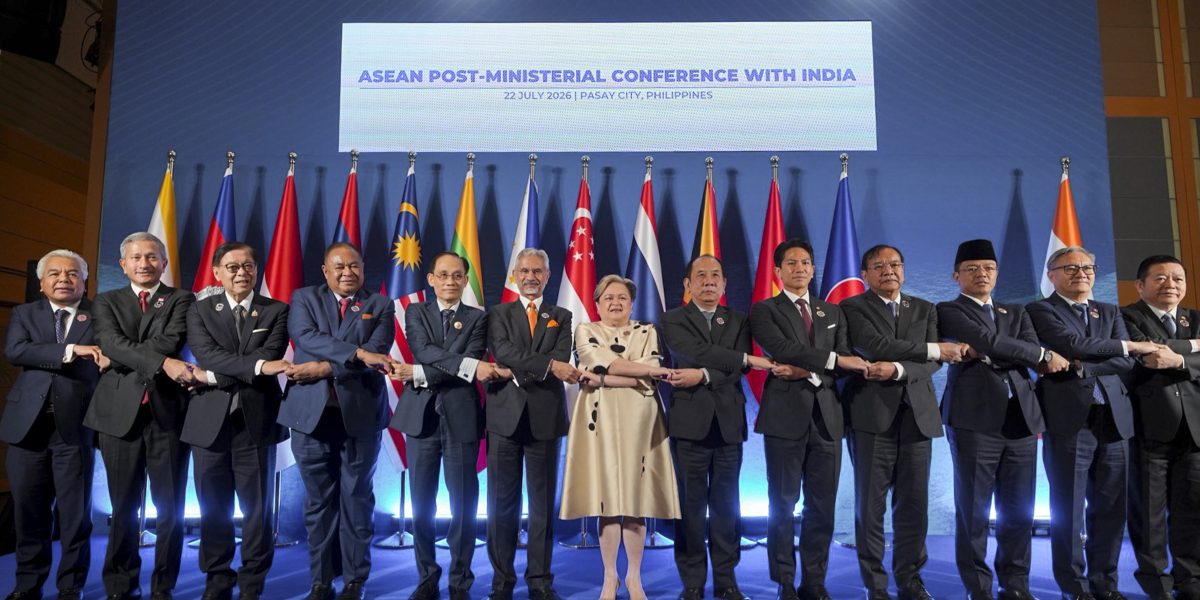
On 22 July 2026, on the sidelines of the 59th ASEAN Foreign Ministers’ Meeting (AMM) in Manila, the foreign ministers of the Quad countries issued a Joint Statement on Cooperation with ASEAN. The statement underscored the quartet’s “unwavering support for ASEAN unity and centrality” and the practical implementation of the AOIP, particularly in maritime and transnational security, economic prosperity, and critical technology.
The July communiqué was the first time the Quad issued a joint statement explicitly dedicated to ASEAN. Prior to that, ASEAN was only loosely referenced as part of the Quad’s envisioned Indo-Pacific region. The declaration extends the Quad’s Joint Statement issued on 26 May 2026 in New Delhi, in which the group expressed “support for ASEAN centrality and unity, and the ASEAN-led regional architecture.”
Furthermore, during a speech in Manila on 10 August 2026 by the US Under Secretary of War for Policy, Elbridge Colby, it was stated that US foreign policy under the Second Trump administration “is much closer to the ASEAN Way than Washington’s foreign policy of the last generation” and that “the US is now taking a page from the ASEAN Way”.
The Quad’s Need for ASEAN’s Support
Although this series of diplomatic signals might be dismissed as mere lip service, the statement reflects a decade-long strategic reality that the Quad requires ASEAN’s support to remain functional.
The lack of ASEAN support for the Quad has long been linked to its reputation as an exclusive US-led grouping. A 2018 elite survey by the Australian Strategic Policy Institute (ASPI) found that 54 per cent of respondents viewed the Quad as an “anti-China bulwark”. When the Quad’s top leadership finally met for its first in-person summit in Washington, D.C., in September 2021, many regional analysts also feared that this minilateral grouping would weaken ASEAN’s primacy as the region’s leading actor.
The perception of the Quad as an anti-China bulwark means that neither ASEAN collectively nor any ASEAN member state individually has ever issued a formal statement supporting the grouping. ASEAN governments remain cautious about issuing formal support, despite growing positive sentiment on the ground. The State of Southeast Asia survey by the ISEAS – Yusof Ishak Institute shows that the share of ASEAN respondents with positive attitudes towards the Quad increased from 45.8 per cent in 2020 to 58.3 per cent in 2022.
While ASEAN can move forward without expressing support for the Quad, the Quad’s evolution shows that this minilateral grouping relies on ASEAN more than ASEAN relies on it. ASEAN remains the only trusted and inclusive institution that even Quad members depend on as the platform for convening their dialogue.
The Quad reconvened for the first time in November 2017, when senior officials from the United States, Australia, Japan, and India met on the sidelines of the 30th ASEAN Summit in Manila. A decade after the groundbreaking summit, Quad foreign ministers met again on the sidelines of the 59th AMM in the same city in July 2026, when the Quad issued the statement.
As the second Trump administration and its “friendly fire” tariffs caused internal disunity among Quad countries, the spotlight naturally returned to ASEAN as the most viable platform for cooperation. The status of “Comprehensive Strategic Partner”, the highest level of partnership, that all four Quad members share with ASEAN illustrates the existing trust in the grouping.
Regaining ASEAN’s Momentum
With trust already in place, ASEAN can capitalise on the Quad’s supportive statement to help stabilise the Indo-Pacific through practical cooperation between the two groupings.
First, ASEAN can pursue an approach to integrate the Quad into a broader ASEAN-led regional architecture. In return for the Quad’s support, ASEAN can issue a statement clarifying the Quad’s potential role and contributions to ASEAN-led institutional networks. Once trust is established, ASEAN and the Quad can hold senior-official-level meetings on the sidelines of the ASEAN-related summit, before upscaling cooperation to a higher level.
Second, ASEAN should translate the July statement’s maritime language into practical cooperation on energy security, maritime security, and humanitarian assistance, as outlined in the July Quad Joint Statement. In particular, the Quad’s Indo-Pacific Partnership for Maritime Domain Awareness can help ASEAN coastal states detect illegal fishing and transnational maritime crime.
Confronting the Stumbling Blocks
While ASEAN-Quad convergence holds potential, internal divisions may prevent cooperation from taking shape. Explicit support for the Quad can elicit opposition within ASEAN, particularly from members who fear appearing to side with an anti-China minilateral group. In response to the Quad foreign ministers’ meeting in May 2026, the Chinese foreign ministry reiterated that it does not support “the formation of exclusive cliques”.
ASEAN’s economic dependence on China gives Beijing the leverage to prevent some ASEAN members and the Quad from converging. As the Philippines seeks to conclude the South China Sea Code of Conduct this year, China has sought to restrict ASEAN members’ engagement with extra-regional powers, including the Quad.
ASEAN’s divergent responses to the South China Sea disputes make consensus on the Quad elusive, while the Quad remains an uncertain partner, as the group has failed to convene the summit that was supposed to take place in India since 2025.
Ultimately, ASEAN’s biggest challenge will be to convince partners, through diplomatic efforts, that meeting with the Quad in an ASEAN-led forum and on ASEAN’s terms signals Quad’s support for ASEAN’s vision of an inclusive Indo-Pacific, rather than for an anti-China bloc. This move will demonstrate and legitimise ASEAN as the primary driver of Indo-Pacific cooperation.
Conclusion
The 49th ASEAN Summit and related gatherings in Manila this November offer an opportunity to shape this potential convergence. The event will bring together all four Quad members and China, providing a fitting platform to explore the possibility of an inaugural Quad-ASEAN senior officials’ meeting.
As chair, the Philippines can use its Chair’s Statement to commend the Quad’s July statement and clarify its role in ASEAN-led frameworks. This approach would provide Singapore, the 2027 chair, with a robust framework for substantiating Quad-ASEAN cooperation, rather than starting from a blank slate.
The Quad’s turn towards ASEAN is an opening that ASEAN should neither fear nor squander. Communiqués alone do not confer ASEAN centrality. ASEAN’s centrality is exercised by setting the substantive agenda for regional initiatives. If ASEAN does so, convergence with the Quad can help stabilise the Indo-Pacific on Southeast Asia’s terms and enable Southeast Asia to deliver practical impact in areas of shared interest, including energy and maritime security, and disaster management.
About the Authors
Arrizal Jaknanihan is a researcher in the ASEAN Studies Programme at The Habibie Center in Jakarta, Indonesia, and an Associate Fellow of the Helsinki Geoeconomics Society. Alfin Febrian Basundoro is a junior lecturer in the Department of International Relations at Universitas Airlangga in Surabaya.
Source
Originally published by the S. Rajaratnam School of International Studies (RSIS), Nanyang Technological University (NTU), Singapore.
The Quad-ASEAN Potential as an Anchor of Indo-Pacific Stability